Emily Dickinson’s Visual Poetry: Lasting Impressions of Her Herbarium
By Veronica Bigio
Say Emily Dickinson’s name in any room and those who hear it will surely recognize it. Most often what is summoned to mind is her prolific poetry, her firmly established originality, or her reclusive nature, but few people know of her earliest work: her singular, and meticulously crafted, herbarium.
Emily’s love of flowers seemed innate from the start, though surely nourished by her mother’s personal garden and the work that went into maintaining it. In fact, Emily spent so much time in the garden that one of her friends referred to her as a flower herself. By the time she turned fourteen years old, she completed her herbarium, and when one examines the pages in its facsimile, it becomes evident that her passion is present on every page, as much as it is in her poetry.
Flowers and plants gave Emily a form of language to utilize, a language she found easy to understand and felt much joy in translating for others. She loved to gift little bundles of floral beauty to friends and family with a brief poem attached, and as she grew into her voice through poetry, she continued to use natural themes to express herself.
It is of no surprise, then, that her herbarium reflects her mind’s intrinsic inclination for poetry. Within its 66 pages, she carefully secured more than 400 specimens, most of which were supplied by her mother’s garden and house plants; other specimens were found in the neighboring area, and a few have since become either rare or extinct. Furthermore, her labels demonstrate little interest in the scientific aspect of producing herbaria – it is clear her attention was in the plants themselves and in the creative process.
Her love for these plants was so authentic, she never inscribed the book with her own name or a title, nor were there any embellishments added to any page. To Emily, the plants were worthy of attention on their own, and she ensured the capture of that attention with the layout of each page. Appreciation for the artistry of her herbarium goes beyond scientific curiosity; within these pages, something deeper can be found: inspiration.
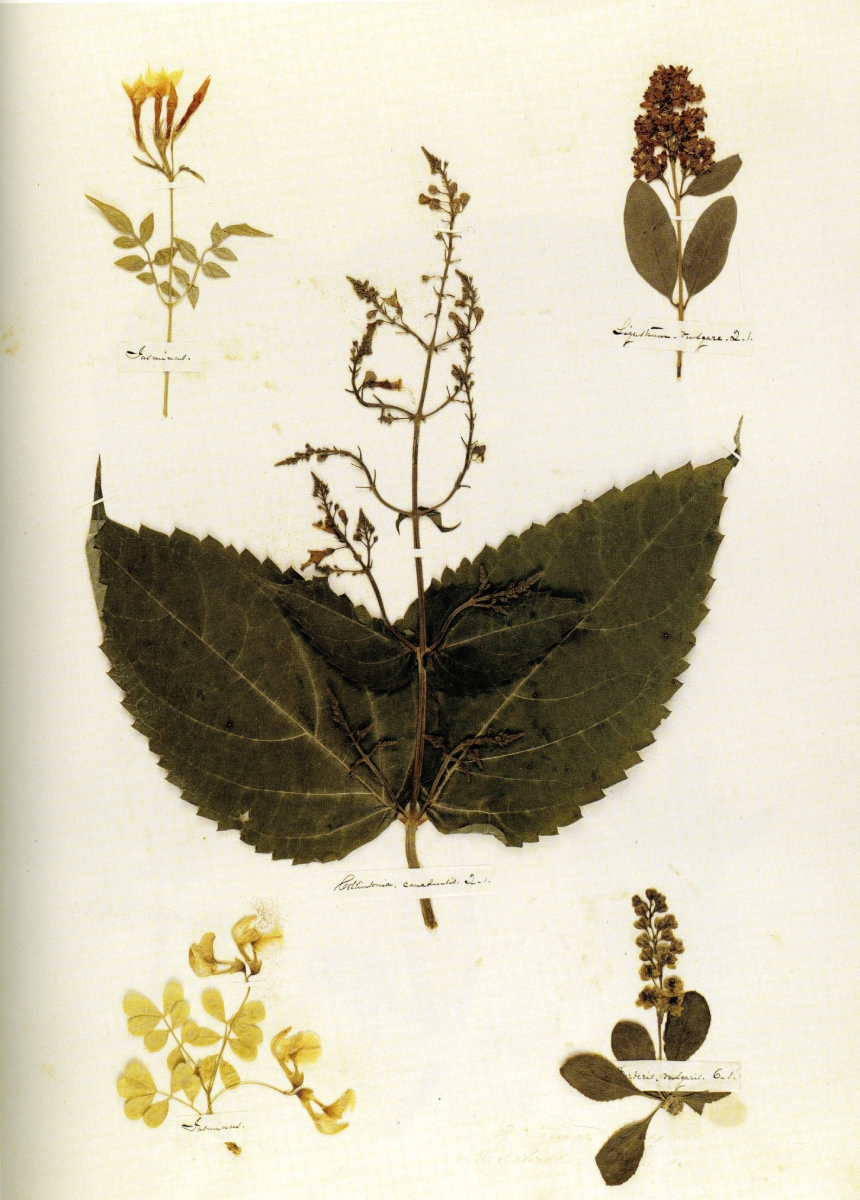
For example, the central plant on the first page of her herbarium – horse balm (Collinsonia canadensis) – is displayed in such a way that the symmetry and spread of the leaves behind the stalk are reminiscent of wings, posed and ready to flutter for flight. This plant is surrounded by smaller flowers in each of its four corners, appearing as beautiful pillars of support for the main focus, yet each deserving of its own attention as well. Such imagery might inspire thoughts of freedom or a leap of faith, perhaps with undertones of cautious optimism with the lighter color flowers aligned on the left side and the darker aligned on the right.
It is interesting to note that originally, all four supporting flowers would have been light in color (yellow and white) when first collected. Whether Emily knew at the time that they would dry in this particular pattern is unknown, but inspiration can still be obtained from this observation.
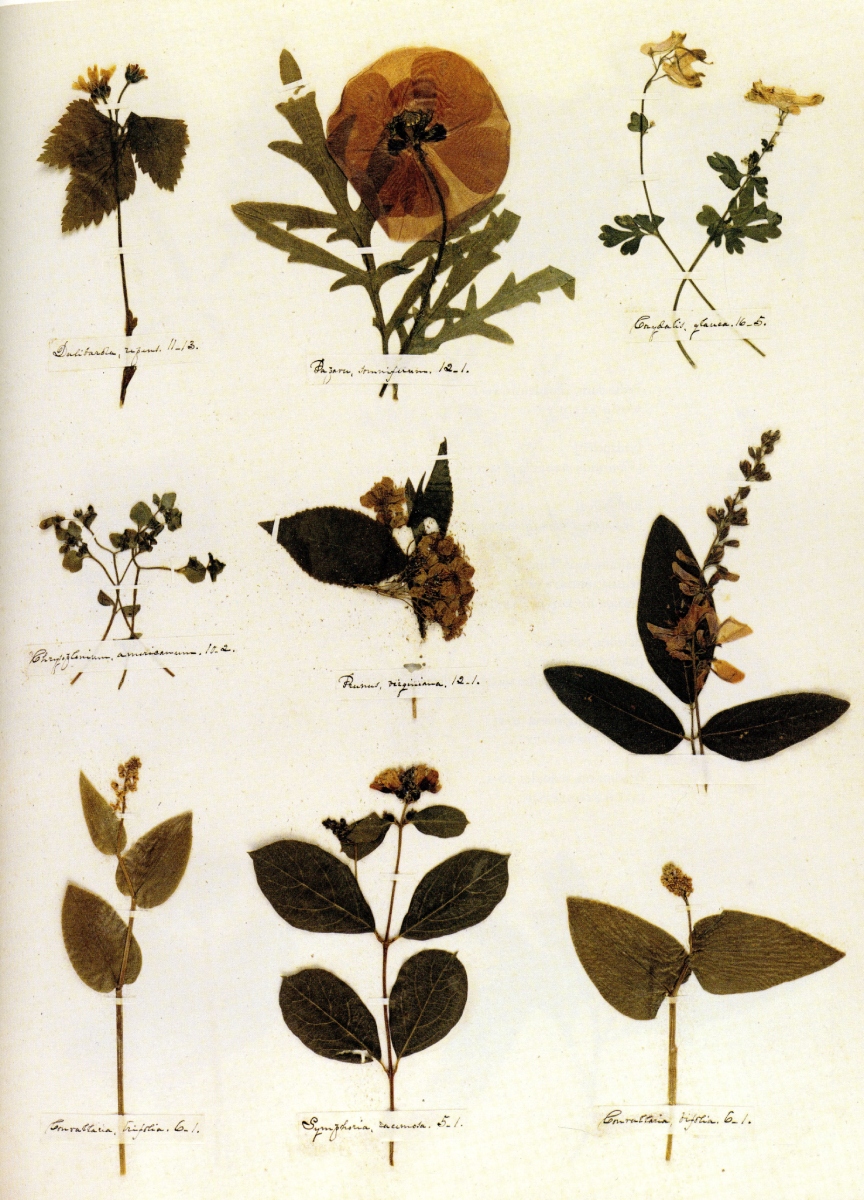
On page 48, the flower situated in the middle of the top row of plants is a common poppy (Papaver somniferum), and as Emily has chosen to arrange it, one image that comes to mind when looking at it is an orange full moon, glowing brightly as it ascends above the horizon. This visual metaphor might evoke a serene sense of hope, for when one is lost in the dark, there is a source of light for guidance reflected by the moon.
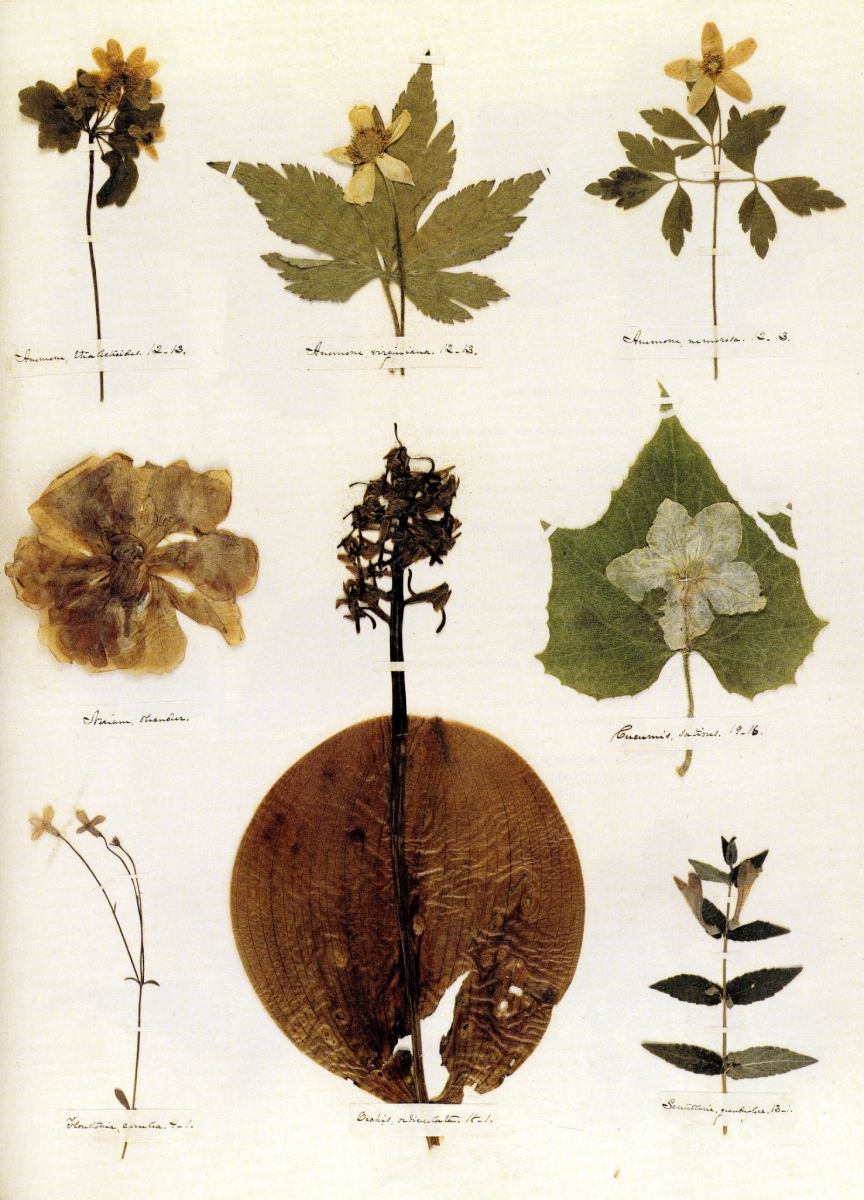
Another plant bears similar elicitations on page 40, the largest plant on the page – the round-leaved orchis (Orchis orbiculate) – presented so assertively that the eyes are compulsorily drawn to it. The tall, sturdy stalk of the orchid is positioned precisely in the middle of the circular leaf, boldly jutting out and inspiring a sense of determination to rise in the midst of a dark night, with the comforting support of a full moon.
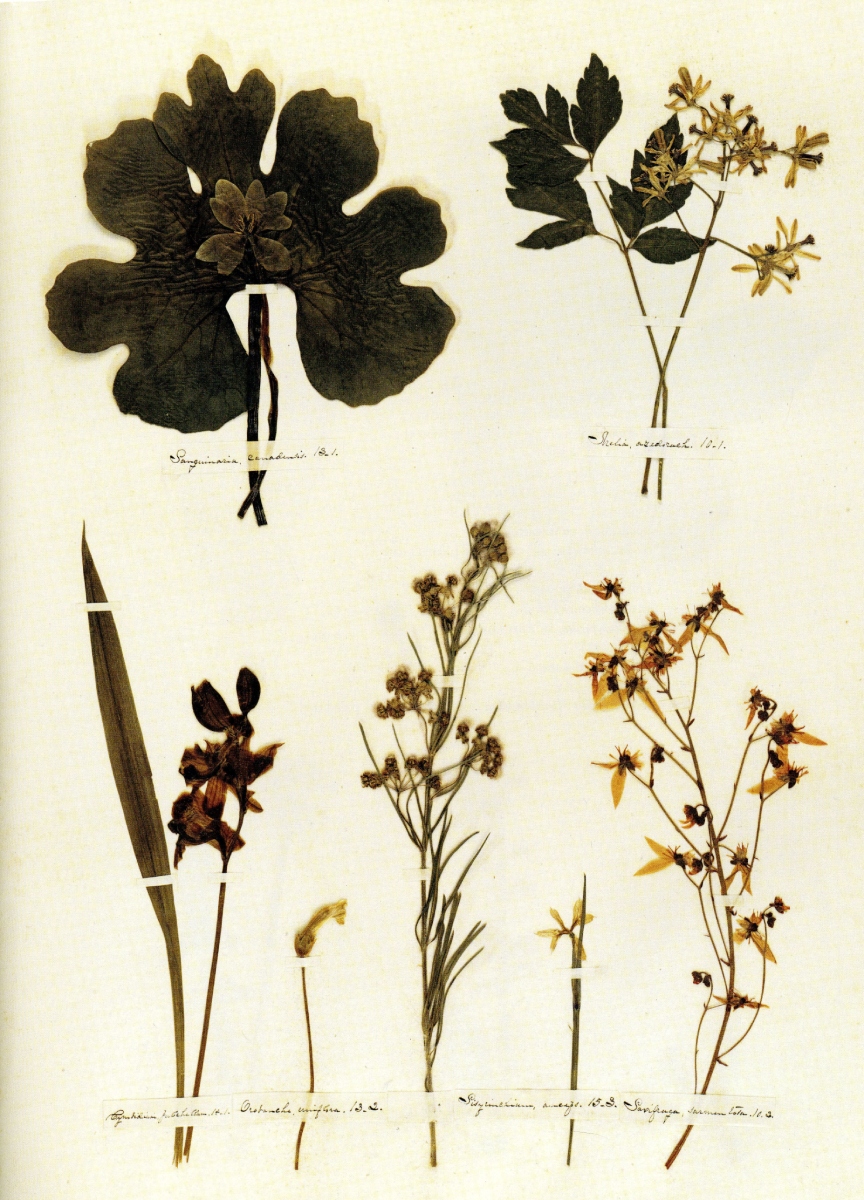
Page 25 opens with a powerful presentation of the perennial bloodroot (Sanguinaria canadensis), with its flower resting in the middle of the bed of its striking leaf, which is so much larger than the flower that it appears protective of it, guarding it closely secured to its chest. Every part of the flower is positioned inside the large leaf, with not even a tip of a petal peeking out from its edge – it is entirely nestled and safe in the arms of its counterpart.
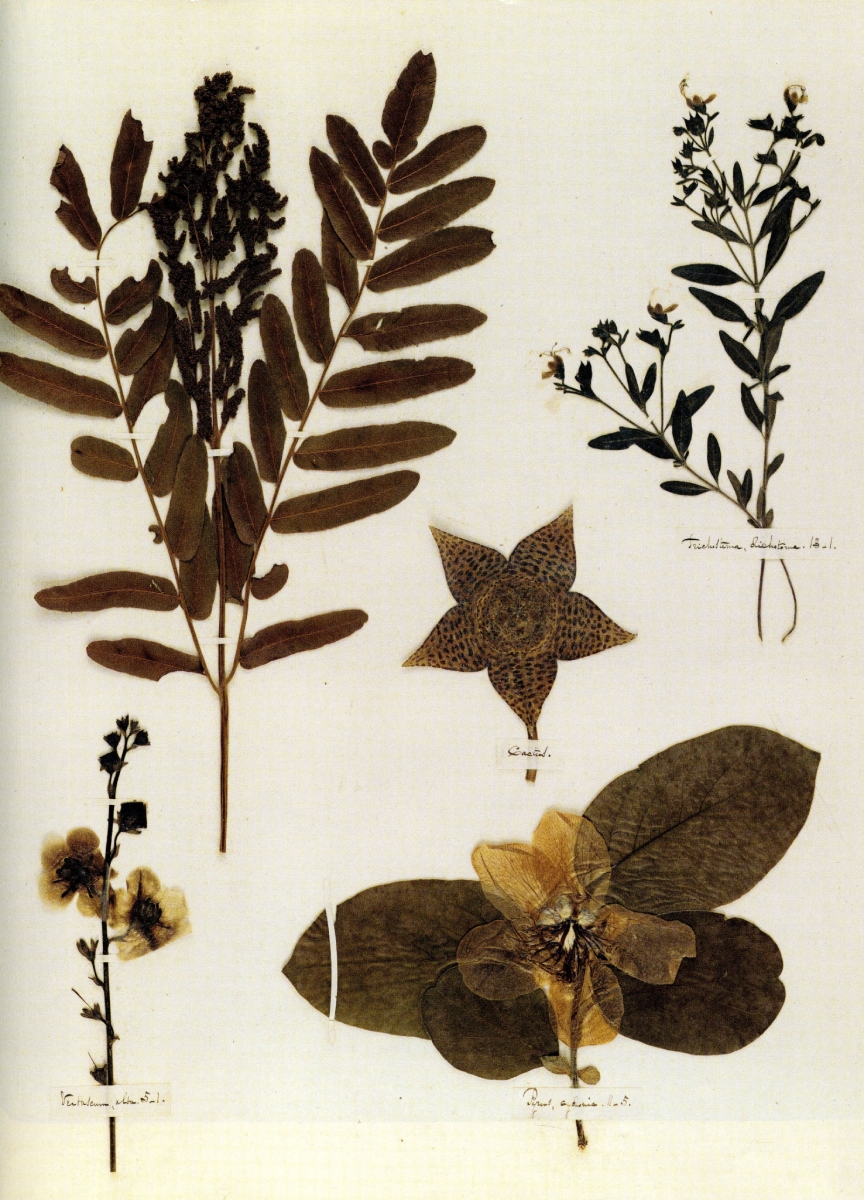
Many pages of Emily Dickinson’s Herbarium can be qualified as inspiring, beautiful and artistic, or even in some cases otherworldly, but one might qualify the final page, page 66, as dramatic, with the petals of the toad cactus (Stapelia variegata) appearing like a spotted star. It is not the largest on the page – that honor goes to the aptly named royal fern (Osmunda regalis var. spectabilis), with its tassels still intact – but it is centralized on the page, and with its corona equally spotted and circling in its center, and with the spots surrounding the corona being slightly warped, much like the gravitational lensing that occurs around black holes, the flower might give the impression of suspended movement. Perhaps it was Emily’s sense of humor that led her to close her herbarium with a flower that is known for having the foul scent of carrion.
Everyone will see something different, each gaining their own insights from this herbarium, which illustrates the multivalent nature of Emily’s distinctive ways of communicating. As a poet and avid admirer of Emily Dickinson, it seems serendipitous that one day, I took a tour of the BRIT Library and discovered her herbarium sitting on one of the shelves. Ever since, I have found endless inspiration within its pages. It is more than a facsimile of her earliest creative work; it is a piece of her, and her natural proclivity to express herself in unconventional ways render it possible to still connect with her. She speaks through each page, each plant – one need only know how to listen.